Development of investment solutions
2025 was an eventful year for equity investors. Stocks rose to new record highs on solid corporate earnings and central bank easing, in defiance of persisting high levels of uncertainty and anxiety that led to a surge in precious metals prices. Investors flocked to AI and defense stocks but avoided the healthcare sector for months due to adverse political factors. It was not until the fourth quarter that some positive momentum was finally seen.
Despite unrelenting geopolitical tensions, above all the war in Ukraine and the fragile situation regarding security in the Middle East, most international financial markets remained remarkably robust in 2025. Many stock markets sustained their upward trends, building on their already good performance from the preceding years, albeit with periods of increased volatility. Wall Street advanced thanks to a solid economic performance, and major European markets also delivered pleasing returns. Tech stocks remained a key driver of the market gains, but there was a shift in investor attention from pure-play AI stocks to companies integrating productive AI into their business and to sustainable earnings models. Commodities showed a mixed performance: thanks to its role as a hedge against risks in an environment characterized by political uncertainty, the price of gold soared as high as USD 4 500 per ounce, while energy stocks were clearly vulnerable to geopolitical developments.
The new US administration was the headline event on the political front. Donald Trump quickly introduced new economic policies at the start of his second term as president, especially for international trade relations. Trade tariffs have become a new reality. The White House «Liberation Day» announcements on April 2, 2025, in particular, created widespread confusion and heightened uncertainty worldwide. Eroding confidence in the US as a reliable trade partner led to a substantial weakness in the USD. In Europe, unresolved structural challenges within the EU and political instability in key EU countries weighed on investment climate. At the same time, however, public investment programs at the national and supranational level – especially for infrastructure, energy supply, digitalization, and defense projects – were announced, triggering optimism and strengthening Europe’s mid-term growth prospects.
At the monetary policy level, the pace of policy easing attracted increasing attention during the course of 2025. The US Federal Reserve (Fed) took a cautious stance, citing persistent core inflation pressure and the continued robust jobs market, and emphasized its data-dependent policy approach. The Fed reduced interest rates in three stages to a range of 3.50%–3.75%. The European Central Bank (ECB) cut its key interest rate four times in 2025, to 2.0%. After the June cut, the ECB left its interest rates unchanged at all of the subsequent rate-setting meetings during the second half of the year, which indicates that Eurozone inflation has become more stable. In Switzerland, the Swiss National Bank’s key interest rate now stands at 0%. Broadly speaking, the 2025 investment year was dominated by a challenging mix of geopolitical risks, monetary policy uncertainties, and structural growth opportunities – an environment that once again lent itself to selective strategies and active asset management.
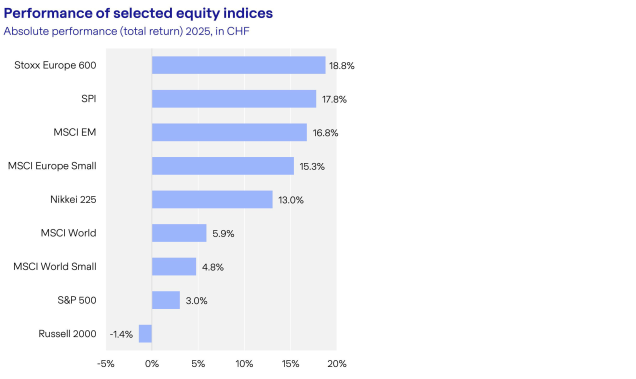
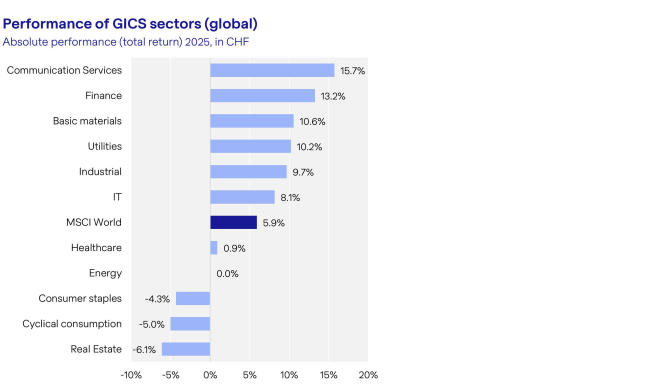
Positive returns were again generated by most of the world’s major stock exchanges last year. However, the weak USD weighed heavily on the investment returns of US equities for investors whose base currency is the CHF. Performance data for 2025 clearly demonstrated the importance of a diversified investment approach. Both the European Stoxx Europe 600 (+18.8%) and the SPI (+17.8%) delivered pleasing double-digit percentage gains in the past year. The same was true for emerging-market stocks (+16.8%), after nearly dropping off investor radar screens, and for Japan’s Nikkei 225 (+13.0%). The S&P 500 (+3.0%) trailed these markets by some distance after years of significant outperformance. From a sector standpoint, communication services (+15.7%), financials (+13.2%), and materials (+10.6%) were the best-performing sectors, while real estate (-6.1%), consumer discretionary (-5.0%), and consumer staples (-4.3%) brought up the rear. The healthcare sector (+0.9%) lagged the broader stock market despite its good performance in the fourth quarter. All performance data is in CHF.
Healthcare – political headwinds, Pfizer deal marks a turning point
Lingering questions about US drug prices (most-favored-nation drug pricing), tariffs on pharmaceutical imports, and Medicare drug price negotiations kept uncertainty in the healthcare sector at elevated levels. That said, there was a steady flow of new product approvals from the FDA, which underscored its commitment to a stable regulatory environment that promoted innovation and rewarded R&D outlays. Although healthcare sector fundamentals were generally very positive, the sector was unable to match the gains of the broader equity market, especially during the first half of the year.
The drug price agreement between the US administration and Pfizer at the end of September and subsequent deals with Eli Lilly and Novo Nordisk in November represented a clear turning point. With these announcements, a more predictable framework with respect to drug pricing and reimbursement policies was finally created. This reduced the general uncertainty in the sector and improved planning visibility. Investors responded quickly to this development: healthcare was one of the top-performing sectors during the fourth quarter (+10.4%), led by buying from institutional and generalist investors. The previously high levels of uncertainty gave way to increasing confidence and a risk-off market environment.
2025 was also marked by high levels of M&A activity. The biopharmaceutical industry still has record amounts of capital to spend, and it is increasingly using this cash to finance strategic transactions. Examples here are Johnson & Johnson’s acquisition of Intra-Cellular for USD 14.6 bn and Novartis’ USD 12.0 bn bid for Avidity, two of many transactions that were announced during the past year. Takeover activity also picked up outside the drug-making industry. Abbott paid USD 23 bn to acquire Exact Sciences and strengthen its position in cancer diagnostics. Primary market activity also increased. The record-setting IPO of US medical technology specialist Medline toward the end of the year sent a clear signal across the IPO landscape. On its first day of trading, Medline’s valuation topped USD 50 bn, which underlines the high level of investor interest.
BB Biotech AG delivered a very pleasing performance in 2025 and clearly beat the Nasdaq Biotechnology Index with a 53.7% gain in its share price (in USD) and a 44.8% gain in NAV. Better macroeconomic conditions and the many clinical, regulatory, and M&A milestones that were reached boosted momentum in the biotechnology sector. BB Biotech’s portfolio highlights were Ionis Pharmaceuticals and Revolution Medicines. Ionis published positive Phase III results for olezarsen in severe hypertriglyceridemia that showed a significant reduction in triglyceride levels with favorable safety and tolerability. Revolution Medicines presented early clinical data that confirmed the high response rates of daraxonrasib and zoldonrasib and received FDA Breakthrough Therapy Designation, which attracted considerable investor interest. In addition, Revolution Medicines’ cancer drug RMC-6236 received a voucher under the FDA’s new Commissioner’s National Priority Voucher (CNPV) program, which is intended to significantly shorten regulatory approval time.
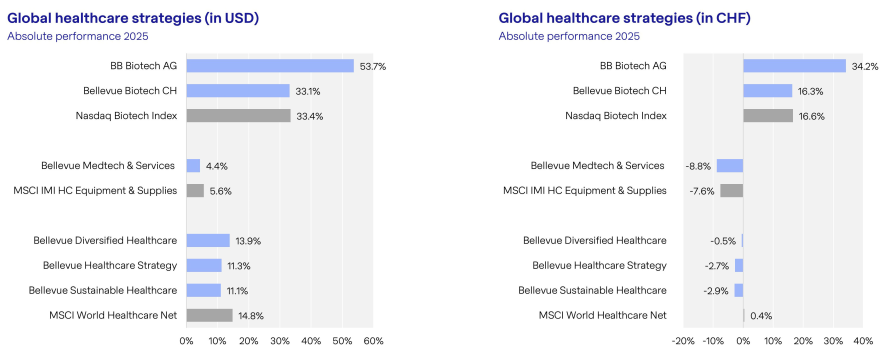
The medtech sector is benefiting from solid surgical procedure volume growth and exceptionally positive developments in key blockbuster markets. For example, Intuitive Surgical reported treatment growth of 18% for the fourth quarter, thereby exceeding expectations. The increasing use of generative AI is leading to lasting improvements in diagnostic tools and treatment options and giving growth an extra boost. Life sciences tools companies such as Thermo Fisher Scientific also advanced on the news of the drug pricing deals in the pharma space. Against this background, Bellevue Medtech & Services (Lux) closed the year with a return of 4.4% and underperformed the broader healthcare market. Bellevue Digital Health showed a similar performance (5.0% in USD).
The global health strategies Bellevue Healthcare Strategy (11.3%) and Bellevue Sustainable Healthcare (11.1%) closed in double-digit territory in USD, slightly behind the MSCI World Healthcare Index due to their particular strategic positioning. This is reflected in their underweighting of Value/defensive large-cap biopharmaceutical companies, which made big gains after the Pfizer deal was announced. Bellevue Diversified Healthcare closed 2025 with a return of 13.9%.
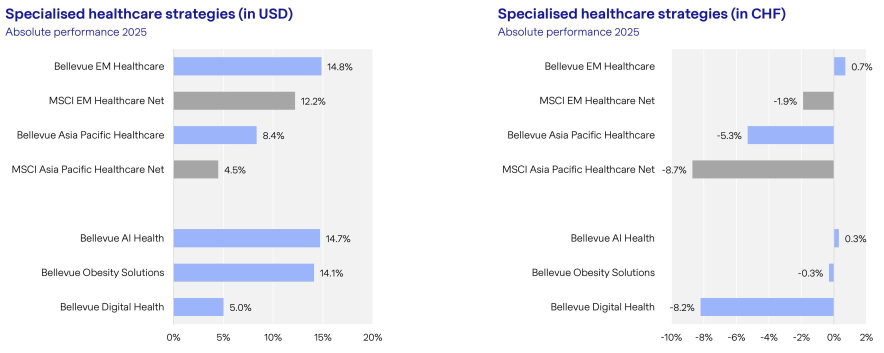
A strong turnaround in USD-terms was shown by the two regional healthcare strategies Bellevue Asia Pacific Healthcare (8.4%) and Bellevue Emerging Markets Healthcare (14.8%). Asia is becoming an increasingly important market for the global healthcare sector. Exciting opportunities beckon, especially in China. The Chinese biotech industry has demonstrated a marked acceleration in innovation in recent years. The number of novel therapeutics originating in China is growing rapidly, a sign that the country has moved from the minor to the major leagues when it comes to biopharmaceutical innovation. This innovative power is making Chinese companies more attractive for international partners. Many of the investigational and approved products have best-in-class potential, are cost-effective, and can help global pharmaceutical companies to strengthen their own portfolios.
The Bellevue Healthcare ETF, which was launched in September, marks a selective expansion of Bellevue’s range of products in the healthcare space. It offers investors easy access to an actively managed portfolio of leading healthcare companies – publicly traded, transparent, and cost-efficient. The ETF has advanced 11.7% since launch.
Europe’s small caps stage a comeback
The Bellevue Entrepreneur Europe Small fund achieved a strong return of +27.5% in 2025, once again outperforming its benchmark index (+19.3%) by a wide margin while maintaining its first-class position in comparison with direct competitors. Portfolio performance was driven by Nordex, Bankinter, Unicaja Banco, Cloetta, and Metso, among other stocks. The Swiss-focused Bellevue Entrepreneur Switzerland (+18.3%) and Bellevue Entrepreneur Swiss Small & Mid (+17.3%) funds also delivered pleasing returns and outperformed their SPI Extra benchmark thanks to positions such as Huber+Suhner, u-blox, Compagnie Financière Tradition, and Swissquote.
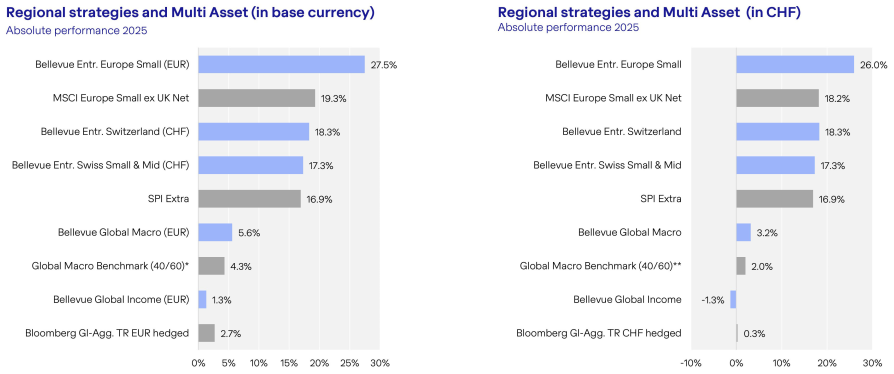
Source: Bellevue Group, as at December 31, 2025
The performance of the Bellevue Global Macro (+5.6% in EUR) fund was broad-based, led by gold and allocations to US and Chinese equities. The Bellevue Global Income (+1.3%) fund also closed the year with a positive return but lagged the Bloomberg Global-Aggregate Total Return Index Value Hedged EUR (+2.7%). In December, the StarCapital Dynamic Bonds and StarCapital Multi Income funds were merged into their respective counterparts, the Bellevue Global Macro fund and the Bellevue Global Income fund. The Bellevue Option Premium strategy was sold to a third party. These strategic adjustments sharpened the focus of Bellevue’s product range and created an attractive platform for growth with high scalability potential.
Arguments for a strong healthcare performance in 2026
The healthcare sector is entering the new year with a strong wind at its back. Visibility surrounding government healthcare policies has improved, and more investment capital is flowing into the sector. Although estimates of future earnings have been increasing in view of the promising innovation pipelines and the emergence of new addressable markets, healthcare stocks are still trading at a discount to the global stock market.
Policy clarity is drawing investors back into healthcare
The agreement reached between the US administration and Pfizer at the end of September 2025 and subsequent drug price deals with Eli Lilly and Novo Nordisk in November marked a significant turning point. A definitive framework for drug pricing and drug reimbursement rates has finally been created, which removed the cloud of uncertainty that had been hanging over the sector and improved planning visibility.
Re-rating has begun – catch-up potential still intact
Healthcare valuations are moving back toward historical averages, but the sector is still valued at a discount of about 10% to global stocks. The outlook is bright: estimated average profit growth for biopharmaceuticals and life science tools for 2024 to 2027 is approx. 15% p.a., which is more than double the historical growth rate of about 7% p.a.
Powerful growth drivers and high M&A capacity in the biopharma space
Novel treatment classifications in oncology, advancements in treating obesity and diabetes, and therapeutic innovations in cardiovascular care are creating additional market volume. Demand for bioprocessing solutions is growing, too, driven by onshoring activity and new production platforms. The biopharma industry is also sitting on a cash pile of more than USD 180 bn that it can spend on M&A to offset lost revenues in the wake of patent expirations or to close strategic gaps in R&D pipelines.
High growth rates in medical technology
Medtech remains a key growth driver, fueled by strong levels of demand in established market segments and the recent emergence of new billion-dollar markets. Robot-assisted surgical systems, glucose-monitoring devices, and structural heart disease treatments are areas that continue to show double-digit growth rates. At the same time, new technologies such as pulsed field ablation are making rapid clinical inroads, and AI smart glasses are gaining market share. At the end of 2025, large-cap medtech stocks were trading on a P/E of 18, which represents a discount of almost 20% versus the S&P 500.
Europe is on the cusp of a cyclical rebound
Europe’s economy has the wind at its back as it enters the new year. Macroeconomic indicators are showing signs of stabilizing, PMI readings have passed their trough, and the ECB is on a more accommodative path. On top of all that, government spending has become a force of its own: Germany has launched a EUR 500 bn infrastructure investment initiative and is committed to increasing its defense spending to 3.5% of GDP. At EU-wide level, another EUR 800 bn has been earmarked for modernization and security programs such as the Defence Readiness Roadmap 2030. Meanwhile, economists are forecasting a sharp upturn in economic activity. According to J.P. Morgan, Europe’s economy could be expanding at around 1% by mid-year 2026 and at an even faster clip of 2% by the end of 2026.
This situation is particularly relevant for European small- and mid-cap stocks. About 60% of their sales are generated within Europe. The past few years have been quite a challenge for SMEs: energy price shocks and a manufacturing recession, not to mention capital outflows of EUR 11.5 bn since 2021, all weighed heavily on the valuation of these stocks. Momentum is starting to shift in their favor though. Investment capital is flowing back into European small- and mid-cap stocks for the first time in years. At the same time, the EU is changing its strategic game plan. There is greater political will to create pan-European business champions. In the past, most M&A activity was confined to the national level – in the telecommunications, energy, banking, or utility sectors, for example. Looking ahead, cross-border consolidation is likely to gain momentum as Europe acknowledges the need for larger, more powerful corporate structures in order to hold its own in global competition with the US and China. Europe is thus entering a sweet spot marked by the convergence of an economic upturn, fiscal expansion, and deeper structural capital market integration.
Nevertheless, small- and mid-cap stocks are still facing an unusual valuation and market situation. In relative terms, European small-cap valuations have not been this low since 2008: with a forward P/E of 14.0x, European small caps are less expensive than European large caps (15.6x) and even more so compared to US small caps (18.6x). The relative valuation of small versus large caps is at a historic low of almost 0.9x.